
TEACHING & MENTORING
How I teach
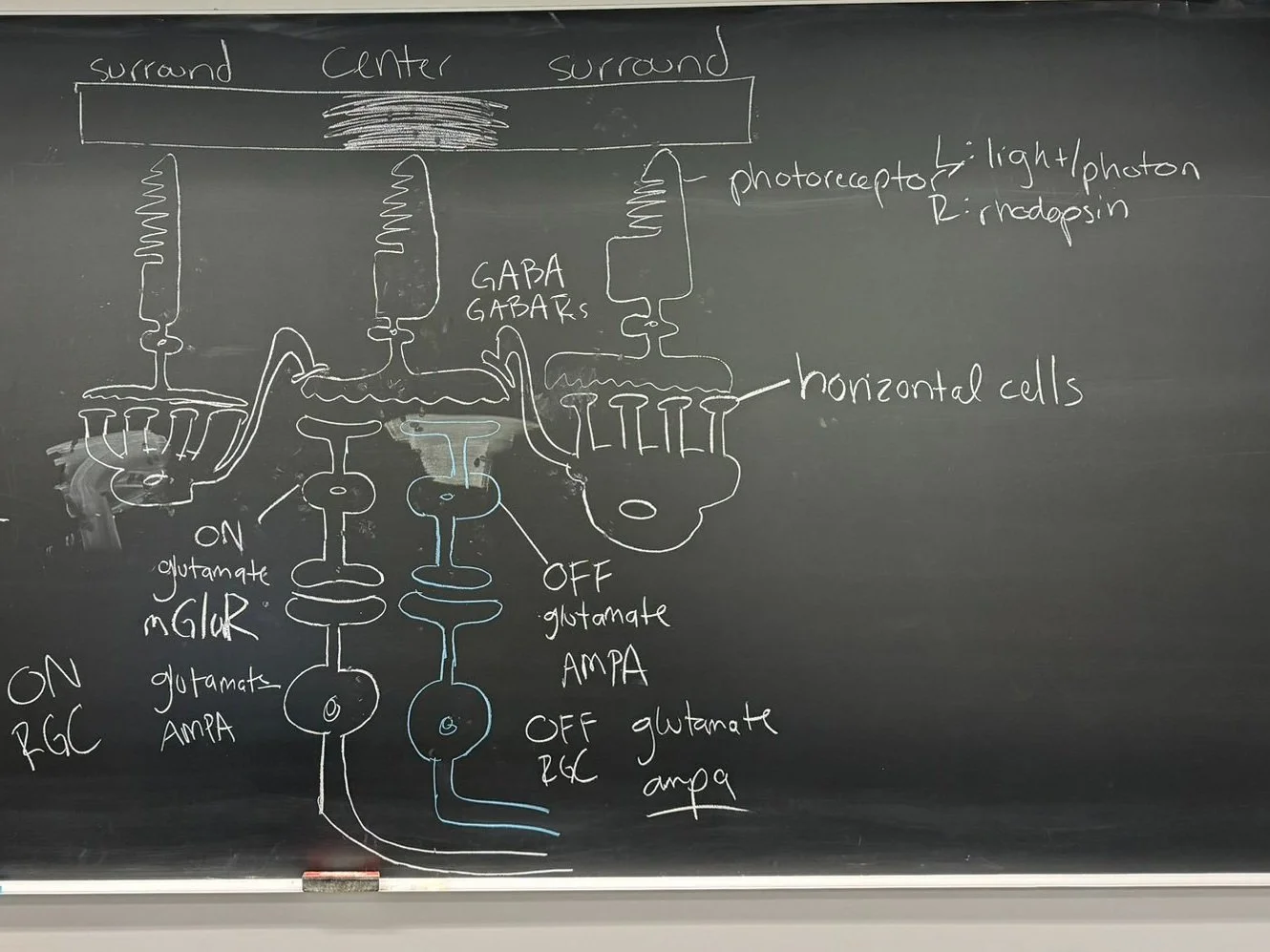
My sections run on active recall. Students work problems at the board, predict what a manipulation will do before I show them the result, and explain mechanisms back to each other. I draw constantly, since most of this material is spatial.
The thing students mention most in evaluations is that I check understanding before moving on. In practice that means cutting material rather than leaving half the room behind.
I came to research through a GED and worked full-time through my undergraduate degree. That shaped how I run a course. I hold office hours at times that work for people with jobs, and I post materials so that nothing essential exists only in a session you had to be in the room for.


Teaching experience
Content Developer, Harvard Office of the Vice Provost for Advances in Learning, 2023–2024 Built assessment materials, including tests and quizzes mapped to each unit's learning objectives, for the HarvardX offering Fundamentals of Neuroscience on edX.
Head Teaching Fellow, MCB80 Neurobiology of Behavior, Harvard University, 2022–2023 Led a team of 14 teaching fellows and worked with the lead professor on curriculum design. Developed hands-on workshops and assignments for 265 students, wrote exams, and graded problem sets. Taught 75-minute discussion sections of 12 to 15 undergraduates and held weekly office hours.
Teaching Fellow, BIOS S50 Foundations of Neuroscience, Harvard University, summer terms 2021 and 2022 Taught the molecular, cellular, circuit, and behavioral curriculum to a mixed cohort of undergraduates in a virtual format.
Teaching Fellow, MCB115 Cellular Basis of Neuronal Function, Harvard University, spring 2021 Taught 75-minute interactive sections for 12 undergraduates on excitable membranes, neurotransmission, ion channels, dendritic integration, and synaptic plasticity, using examples from real neuronal circuits. Fully remote.
Teaching Fellow, MCB80 Neurobiology of Behavior, Harvard University, 2020–2021 Designed and taught weekly sections on perception, learning, memory, emotion, and neurological disorders. Co-developed exams and problem sets, and ran weekly office hours across both remote and in-person formats.
Awards
Four Certificates of Distinction in Teaching, Harvard University, 2021–2023.
Writing and public teaching
I spent four years at Harvard Science in the News, as Managing Editor from 2020 to 2024 and as a science writer from 2022, leading an editorial team of three and overseeing five to six publications a year. I write about post-infectious illness and research policy at Let the Data Speak, and I teach neuroscience to a general audience as @letthedataspeak on TikTok and Instagram. I've spoken at the Pint of Science festival in 2025 and 2026, and I taught neuroscience lessons to 16 middle-school classes across the US and UK through Skype a Scientist.
Supervision
Research supervision
I've supervised nine research trainees across two labs. Three of the rotation students chose to join the lab they rotated through. Two have gone on to PhD programs, at St. Jude Children's Research Hospital and Johns Hopkins University. Two are co-authors on my first-author study of gestational psychedelic exposure.
I try to give each trainee a question of their own instead of a piece of someone else's experiment. A rotation is ten weeks, which is enough time to own something small and find out whether you want this work.
Mentoring beyond the lab
I mentor through the Harvard Research Scholar Initiative, Project SHORT, and the Científico Latino Mentorship Initiative, where I also review applications and conduct mock interviews. I coordinated peer mentoring for Harvard's summer undergraduate research program, served as a peer mentor in the Program in Neuroscience, and sat on its admissions committee as a student interviewer. I also run an academic coaching practice and coach Gilliam Fellowship applicants. In 2022 I received the Excellence in Service Award from the Harvard Program in Neuroscience.